AI Process Optimization: How It Improves Business Processes, and When It Doesn't
Where artificial intelligence actually improves business processes in 2026 - document intake, support, voice agents, sales research, forecasting, inspection, fraud - where AI agents help and where they break legacy systems, and how to scope a first AI process optimization project.

Every company I talk to wants the same thing from AI: the process that eats a team’s week should take an afternoon. Some of them get it. Most of them get a pilot that never leaves the demo.
The difference is rarely the model. Artificial intelligence is not the scarce part any more; a process worth automating is. AI process optimization pays off when a step is repetitive, measurable, and has data behind it - and quietly fails when it is applied to a process nobody has written down. Whether you call it AI for business optimization or business process optimization with AI, the test is the same.
This guide was first written in 2021. The examples in that version - RPA bots in government back offices, a 2018 copywriting tool, robots learning to work next to people - read like history now. This update replaces them with what we see running in production in 2026, and adds the part the old version missed entirely: where AI agents help, and where they make a system worse.
Examples of AI in business processes in 2026
1. Document intake: AI for business process automation
Invoices, insurance claims, loan applications, purchase orders, onboarding forms. They arrive as PDFs, scans, emails and spreadsheets in a hundred layouts. Classic robotic process automation (RPA) handled them with templates and broke every time a supplier changed a form. Process automation with AI keeps the rules and adds a reader. A language model now reads the document, extracts the fields, checks them against your rules, and a person only sees the exceptions.
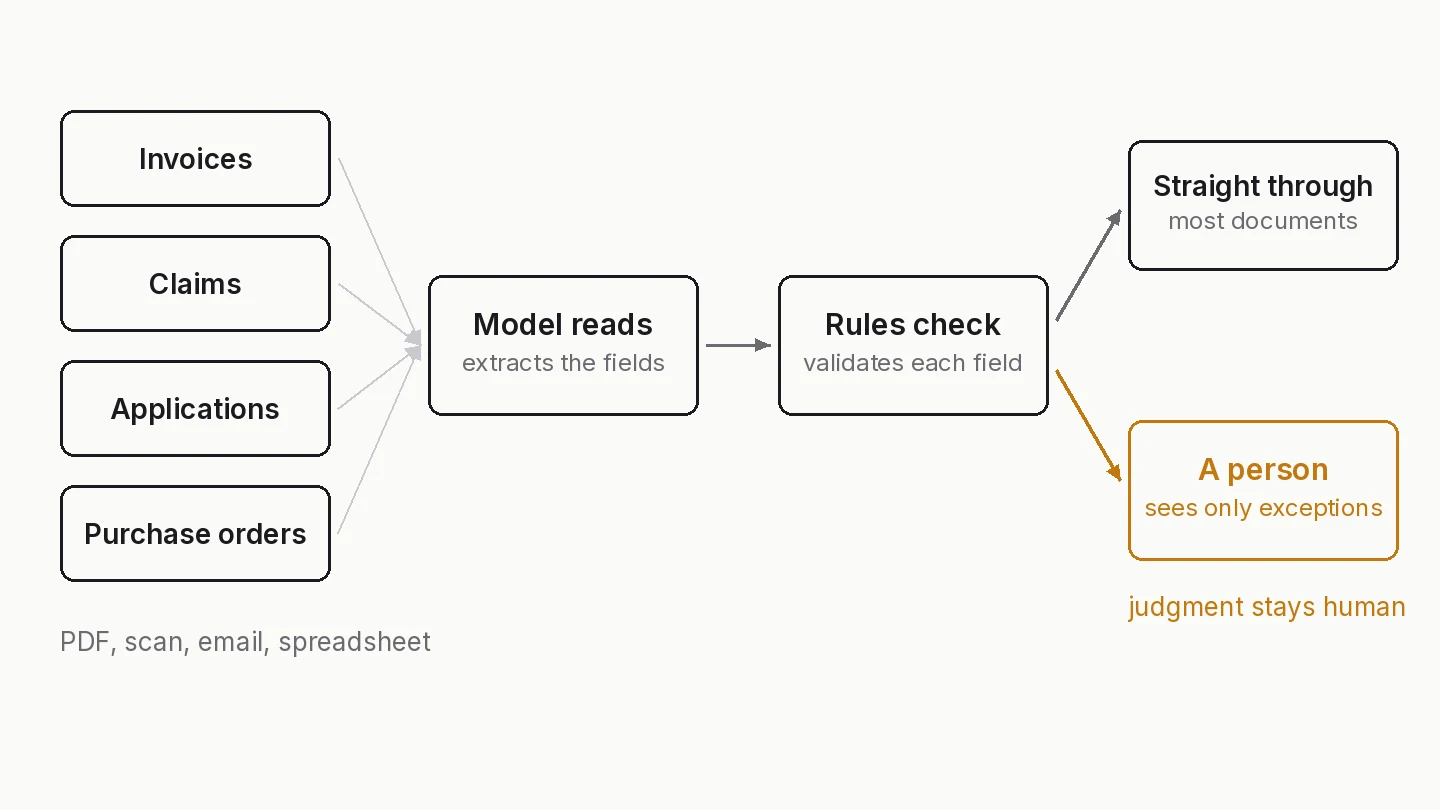
This is the cleanest AI process optimization case there is, and the best argument for AI for process optimization in general: the volume is high, the data already exists, success is easy to measure (fields right or wrong), and the human stays in the loop exactly where judgment is needed. Where fixed rules run out, artificial intelligence takes over the judgment part of the step - and the rules still handle the rest. Robotic process automation does not disappear; it becomes the part of process automation that clicks, while the model decides.
2. Customer support that resolves, not deflects
In February 2024 Klarna reported that its AI assistant handled two-thirds of customer service chats in its first month, the equivalent of 700 full-time agents. A year later the company started hiring human agents again because quality on the harder conversations had dropped.
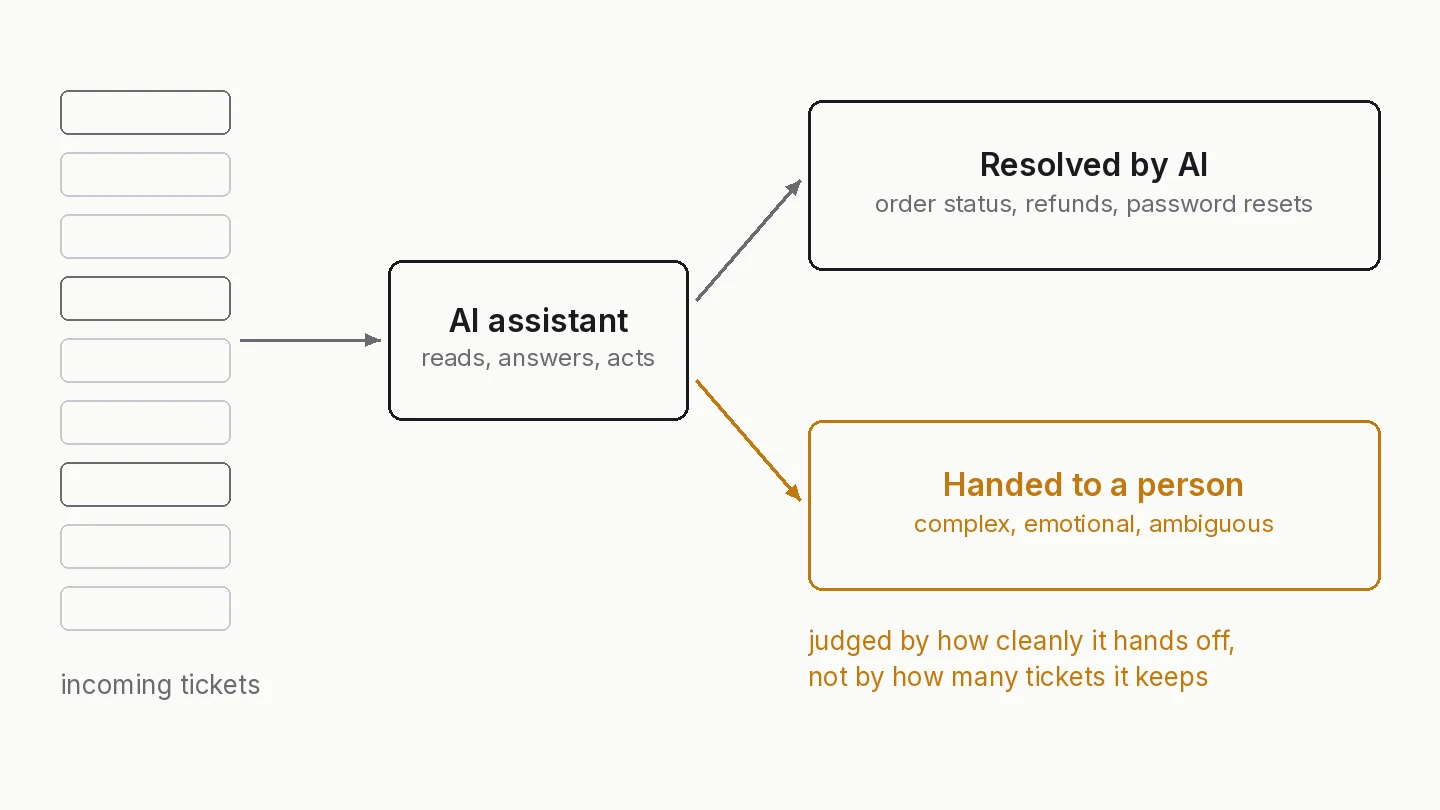
Both halves of that story are the lesson about AI for business processes. Artificial intelligence takes the routine tickets - order status, refunds, password resets - at a fraction of the cost. The complex, emotional or ambiguous ones still need a person, and a production chatbot is judged on how cleanly it hands those off, not on how many it keeps.
3. Voice agents on the phone line
Scheduling, reminders, lead qualification, after-hours answering - business process AI on the phone line. Voice was the channel AI could not handle until speech models got fast and natural enough; now it is one of the most direct AI in business process wins, because every call has a clear outcome and a known cost per minute. Our own voice agents make thousands of calls a day.
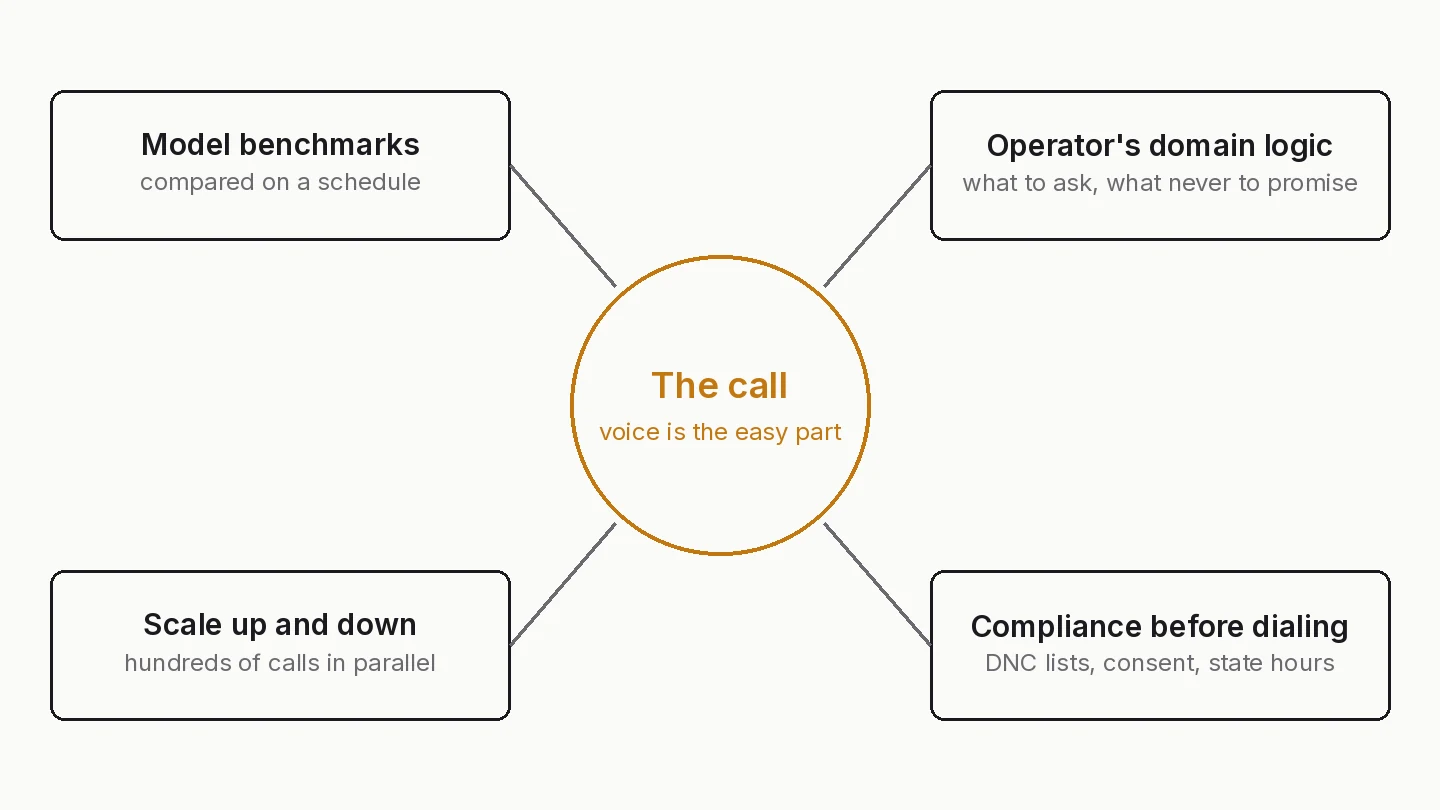
The voice is the easy part to demo and the smallest part of the work. What makes a voice agent hold up in production is the engineering around it:
- Model choice is never final. Speech recognition, the language model and the voice all improve every few months. We benchmark our stack against the best models on the market on a schedule and swap a component when the numbers say so, not when a vendor announces something.
- Domain logic comes from the operator. The agent is only as good as the rules of the business it runs: what to ask, what never to promise, when a call must go to a person. That knowledge comes from the founder who has run the business, not from a prompt template.
- Scale in both directions. A campaign can need several hundred calls in parallel at 9 a.m. and a handful at noon. The system has to scale up smoothly without dropped or delayed calls, and scale back down so you do not pay for idle capacity.
- Compliance is part of the call flow. Do Not Call lists, consent records and calling-hour rules differ between US states. Checking them happens before the agent dials, as code, not as a policy document.
Each of those is a pile of logic that needs expertise, and together they decide whether an AI voice agent is a demo or a phone line you can trust. How we build them - voice included - is on our AI agent development page.
4. Sales and marketing research
The useful part of AI in sales is not writing cold emails. It is the work around them.
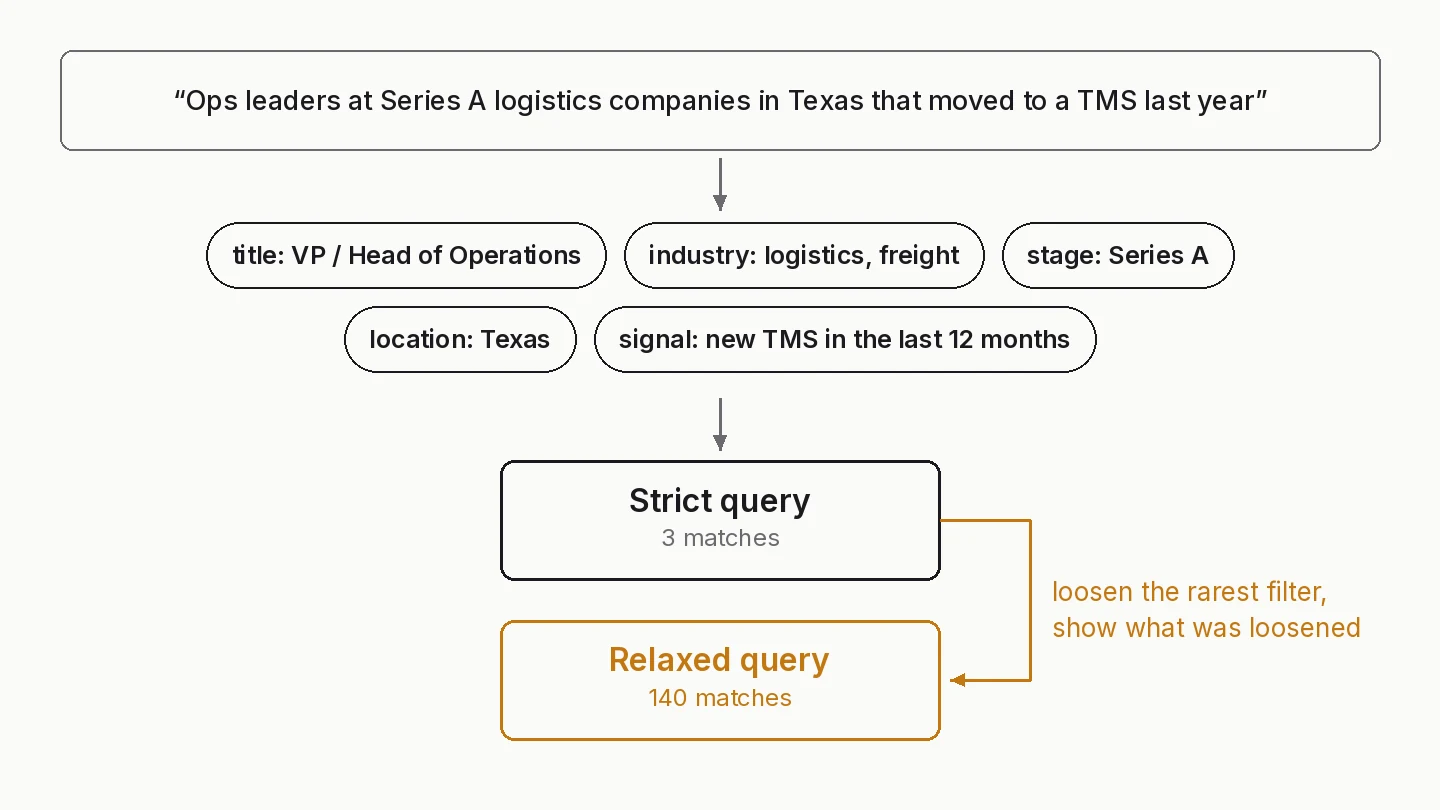
Finding the leads. A good lead list starts as a sentence: “operations leaders at Series A logistics companies in Texas who moved from spreadsheets to a TMS in the last year.” Turning that into a database query is harder than it looks - the sentence becomes dozens of filters across titles, industries, company stage, location and history, the vocabulary never matches the database exactly, and a strict query often returns almost nothing. Translating a plain-English brief into a precise query, and loosening it step by step when it is too narrow, is a problem language models solve well. We have done a lot of work on exactly this in the AI sourcing agent we built for a staffing platform, where a recruiter’s one-sentence brief becomes a search over millions of profiles.
Researching them. Reading a prospect’s site, filings and hiring pages, summarizing what changed, and scoring the account against your ideal customer.
Writing in your voice. AI-generated outreach reads as generic because the model knows nothing about you. The more context you give it - who you are, how you talk, the use cases you have actually shipped, what you offer and what you refuse to do - the more the message sounds like a person with a point of view instead of a template. A written tone of voice with examples is the cheapest upgrade most sales teams can make to their AI.
Personally, I think outreach should still sound like the person sending it - even though in practice very few people write messages by hand any more. Most teams use language models to save the time, and I do too. My own rule sits somewhere in the middle: I let the model draft, then I read every message before it goes out. If it says what I actually think, I approve it and send it. If I have not read it, it does not go. To my mind, a message is part of a relationship, and I would not automate a relationship blind.
Content works the same way. Every language model can draft product copy now, so the bottleneck moved from generation to review: the useful automation drafts in your voice, checks the draft against your product data, and flags what a human needs to see.
5. Forecasting and planning
The oldest use of machine learning in business, and of artificial intelligence in general, is still one of the most valuable: demand forecasting, inventory planning, churn prediction, pricing. This is cognitive insight in the classic sense - big data about customers and operations, pulled through models that predict the next month. It needs history, not language models: machine learning algorithms and, for large catalogs, deep learning on big data. For many companies cognitive insight is the first AI project that pays back. Amazon’s recommendations are the famous example; a regional distributor forecasting what to stock next week is the common one.
6. Quality inspection in manufacturing
Computer vision on the production line, trained with deep learning: cameras that catch surface defects, missing parts or wrong labels at line speed. Robots have run factories for decades, but traditional robotics repeats; it does not see or learn. Adding vision is what intelligent automation means on the factory floor, and it is measurable to the part: defects caught, false alarms, line stops.
7. Recruiting and matching
Ranking candidates against a role, matching freelancers to projects, pairing buyers with suppliers. These are ranking problems over large pools of job applications, and they reward good data and machine learning algorithms more than clever prompts. We built one for a staffing platform; the AI sourcing agent case study covers what it took to make the ranking trustworthy enough that 200 recruiters use it daily.
8. Security and fraud triage
Fraud models on transactions have run for years; artificial intelligence security systems learn what normal looks like and flag the rest. What is new is triage: security teams drown in alerts, and a model that reads each alert, pulls the context and writes a first assessment turns a queue of thousands into a short list a person can actually review. Businesses that work with plenty of financial transactions use the same pattern for payment disputes and compliance checks.
9. Software engineering with coding agents
Coding agents - artificial intelligence that writes features, tests and migrations - are the newest entry on this list. For a new product they are a real speedup, and the machine learning behind them improves every quarter. For an old one, the picture is different - and that difference deserves its own section.
Where AI agents help, and where they break things
From our own projects, artificial intelligence agents are good at tasks that can be solved in many acceptable ways, with few hard constraints. Drafting, research, prototyping, a new service with no users yet. If the agent takes a different path than you would, the result is still fine.
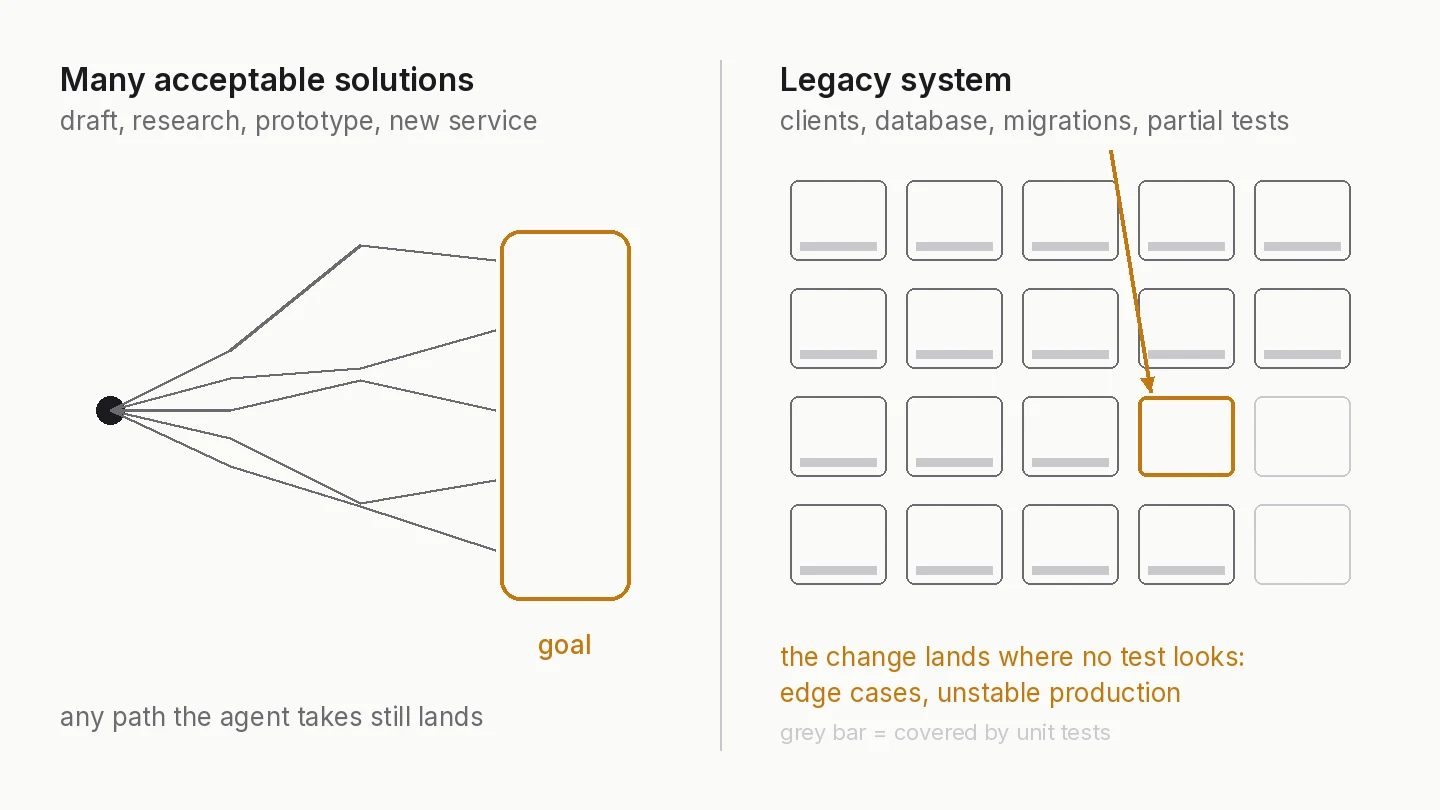
The opposite case is a legacy system. It is the backbone of the business processes that pay the bills: years of clients, a database with history in it, an architecture, a suite of unit tests, and migrations that hurt every time. Here an agent does not help much yet. It tweaks a prompt inside the wrong agent architecture, or it goes looking for a better solution and changes things nobody asked it to change. The unit tests cover part of the behavior; the edge cases they miss show up as unstable behavior in production.
That is a real problem, because a product cannot stay still. Clients give feedback, markets move, the technology underneath changes every year. The system has to keep improving, and every improvement to a fragile system is a risk.
So the ability to change has to be designed in. Not after the fact - either before the product is built, or at the moment it moves from MVP to a real system. That design work cannot be delegated to an agent. Someone has to hold the vision: what the system should do, what it should never do, where its limits are, and how the product will actually be sold and used. That is the hard part of building with artificial intelligence, and it is still human work.
Where AI process optimization does not pay off
The 2021 version of this article ended with predictions about AI chips, 5G, and blockchain. Artificial intelligence companies will happily sell you AI business process optimization solutions before anyone has checked whether the process qualifies. I would rather spend the space on the cases where I tell a client not to do the project:
- The process is not written down. If three people run it three ways, there is nothing to automate yet. Document it first, then automate the documented version.
- The volume is small. An AI business optimization project that saves two hours a week will not pay for its own maintenance, whatever artificial intelligence you put behind it. Below a few hundred cases a month, a template or a checklist wins.
- The data does not exist. Deep learning and machine learning algorithms need data to work, in many cases big data. A model that routes support tickets needs a history of routed tickets. If the history is in people’s heads, budget for collecting it before modeling.
- The exception rate is the point. If every case is different and the value is in human judgment, AI can assist, not replace. Scope it as a copilot, not an automation.
- The process lives inside a fragile legacy system. Automating on top of it moves the fragility into production. Fix the architecture, or put the AI at the edge where it reads and suggests rather than changes.
Final words
Artificial intelligence is developed by engineers, but it works for operators. The business processes that pay back first are the boring ones: documents, tickets, calls, forecasts built on big data you already have. Since artificial intelligence is applicable to almost any scenario, the constraint is rarely the model - it is whether the process is ready for it. AI can help most where the work is repetitive and measurable. Nearly every business process can be optimized: if you can speed it up, make it cheaper, or make it better, AI business process optimization can probably help - provided the process is repetitive, measurable, has data behind it, and sits on a system built to change.
If you are scoping a first project, our AI agent cost calculator gives a build and running-cost estimate in a few minutes, and our AI agent development engagements start with a fixed-price pilot on one real process. If you are still deciding between an in-house team and outside help, the data science consulting buyer’s guide lays out the costs and the questions to ask.
FAQ
What is AI process optimization?
AI process optimization is using machine learning, language models, or computer vision to make a business process faster, cheaper, or more accurate: automating a step, predicting an outcome, or routing work. It is worth doing when the process is repetitive, measurable, and has data behind it.
Will RPA be replaced by AI?
Partly. RPA scripts click through fixed screens and break when the screen changes. LLM agents can read the screen or the document and decide what to do. For stable, rule-based flows RPA is still cheaper; for anything with variation, agents are already replacing it.
Can AI agents improve a legacy system?
Not much, today. Agents do well where a task has many acceptable solutions and few constraints. A legacy product has years of clients, a database schema, migrations that hurt, and unit tests that cover only part of the behavior. An agent looking for a better solution there tends to change things nobody asked it to change, and the result is edge cases the tests miss and unstable production. The fix is architectural: design the system so it can change, and keep the design decisions with people who understand the product.
Which is the best example of process optimization?
Document intake is the cleanest example: invoices, claims, or applications arrive in many formats, a model extracts the fields, validates them against your rules, and a human only sees the exceptions. It is measurable, the data already exists, and payback is usually under a year.