How much does an AI agent cost?
Two numbers hide behind one question: what an agent costs to build — for us, a fixed-price pilot between $30–50K — and what it costs to run every month, driven by volume, model choice, and hosting. The calculator below estimates both from public pricing and our production systems — because how much does an AI agent cost has no honest one-line answer, only an honest breakdown.

Your agent, two numbers.
Four price bands — and where we actually sit.
| Off-the-shelf platform | Usage-based agent | Enterprise multi-agent | Custom build — BroutonLab | |
|---|---|---|---|---|
| Upfront cost | ✓ $0 — subscribe from $20/mo | $0 — you pay per outcome | ✕ $100K+ phased, plus procurement | $30–50K before the first production call — the biggest entry ticket outside enterprise |
| Time to live | ✓ This week — assemble it yourself | Days, inside your helpdesk | ✕ Quarters, with security review | 2–4 months to production |
| Cost at scale | Grows per seat — tolerable | ✕ Grows with every ticket — worst at volume | High but amortizes across departments | ✓ Near-raw inference — flattens as you grow |
| Integration depth | ✕ Templates and public APIs only | One helpdesk, that's the point | ✓ Everything, including the 15-year-old ERP | ✓ Any system you run — CRM, calendar, legacy |
| Who owns it | ✕ The vendor — you rent | ✕ The vendor — you rent per outcome | ✓ You, with compliance paperwork to match | ✓ You, from day one: code, models, data |
| Best for | Solo operators testing whether an agent helps | Tier-1 support at moderate volume | Regulated industries, multi-department rollouts | Founders and mid-market automating real workflows |
The right way to read this table is by use case, not by column. If you're a solo operator or a small team still testing whether an agent helps at all, an off-the-shelf platform is the right answer — $20–500 a month buys you the experiment, and nothing on this page should talk you out of it. If your problem is tier-1 support living inside one helpdesk at moderate volume, a usage-based agent is genuinely hard to beat below the crossover: you pay only for closed tickets and carry zero engineering.
Custom earns its entry ticket in a specific situation: the workflow you're automating reaches past what a helpdesk widget can touch — into your CRM, your calendar, your order data, your legacy systems — and its volume is heading past the point where per-outcome pricing compounds against you. That's the founder and mid-market case, and it's the one this calculator is built for. To be precise about what $30–50K buys: not the whole journey, but a bounded first project at a fixed price — one workflow in production that proves the approach and builds trust before you commit further. Growth continues with a dedicated team from $15K/month. What none of these numbers do is scale with your ticket volume — that's the difference from rent.
The enterprise column isn't a different philosophy — it's the custom path with compliance, self-hosting, and more departments attached. We get clients there through phased pilots rather than one giant contract, which is why the enterprise engagements on our side still start at the same $30–50K increment.
Two honest notes to close on. The platform and usage-based columns are real options, and sometimes the right ones. If that's your case, we'll say so on the first call — even though it costs us a deal.
And when you weigh the options yourself, spend the most time on one row: cost at scale. Rent rises with your success; ownership doesn't. In our experience that single row decides more agent budgets than all the others combined.
AI agent development cost: what moves it.
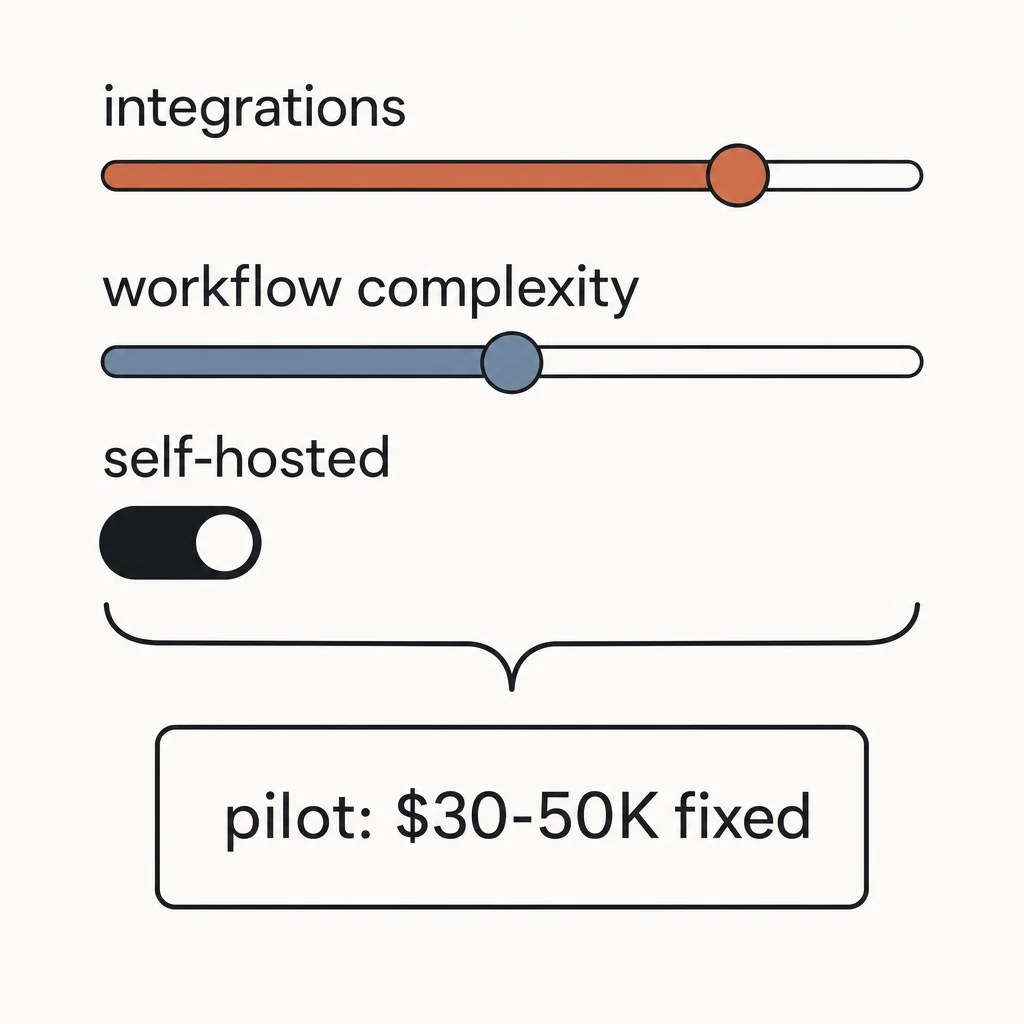
Every agent we build ships inside the same fixed-price pilot — $30–50K, 2–4 months, scope in writing — so the question isn't whether the budget explodes, it's where within the range you land.
Integrations move it most: an agent that acts on one system is a different project from one that orchestrates five. Self-hosting adds deployment and ops work. Complexity of the workflow — how many steps, how much can go wrong — sets the guardrail and evals budget.
The AI agent price a platform quotes hides usage fees that grow with you; ours is fixed and stays yours. After the pilot, a dedicated team from $15K/month continues the roadmap; the AI agent development page covers what that engineering actually is.
AI agent cost per month: the running bill.
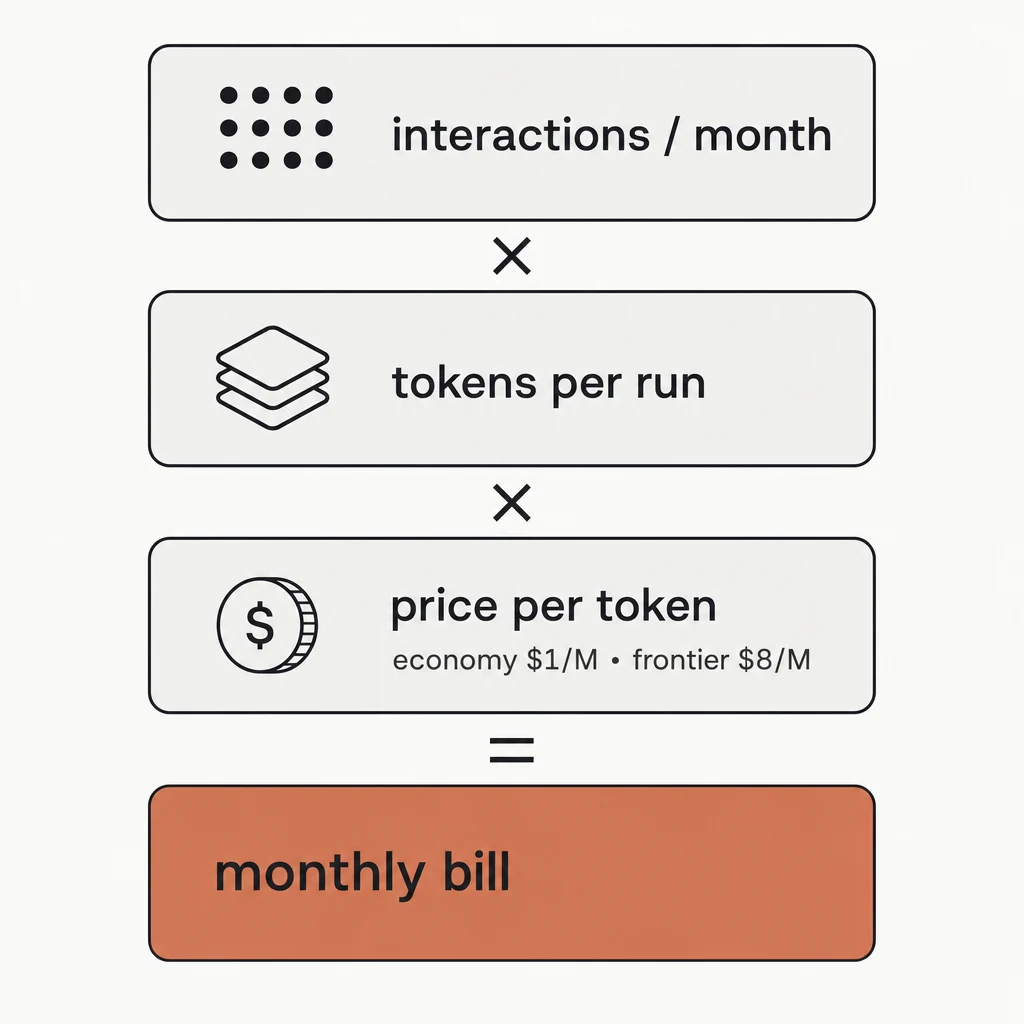
Running cost is arithmetic: interactions × work per interaction × model price. A simple routing agent burns ~15K tokens per run; a multi-system autonomous workflow can burn 100K.
Economy-tier models cost around a dollar per million tokens, frontier models several times that — which is why typical AI agent costs run anywhere from $200 to $4,000 a month depending on choices you control — complex agentic AI costs more per run simply because it does more.
Self-hosting swaps per-token fees for infrastructure: a GPU baseline that beats API pricing once volume is high enough. The full cost of AI agents in production also includes the cost of AI agent monitoring: evals and alerts that catch drift before your customers do. Put together, that's the real answer to how much does an AI agent cost: a capped build plus a monthly bill you design, not a number someone guessed.
Hidden operating costs — named upfront.
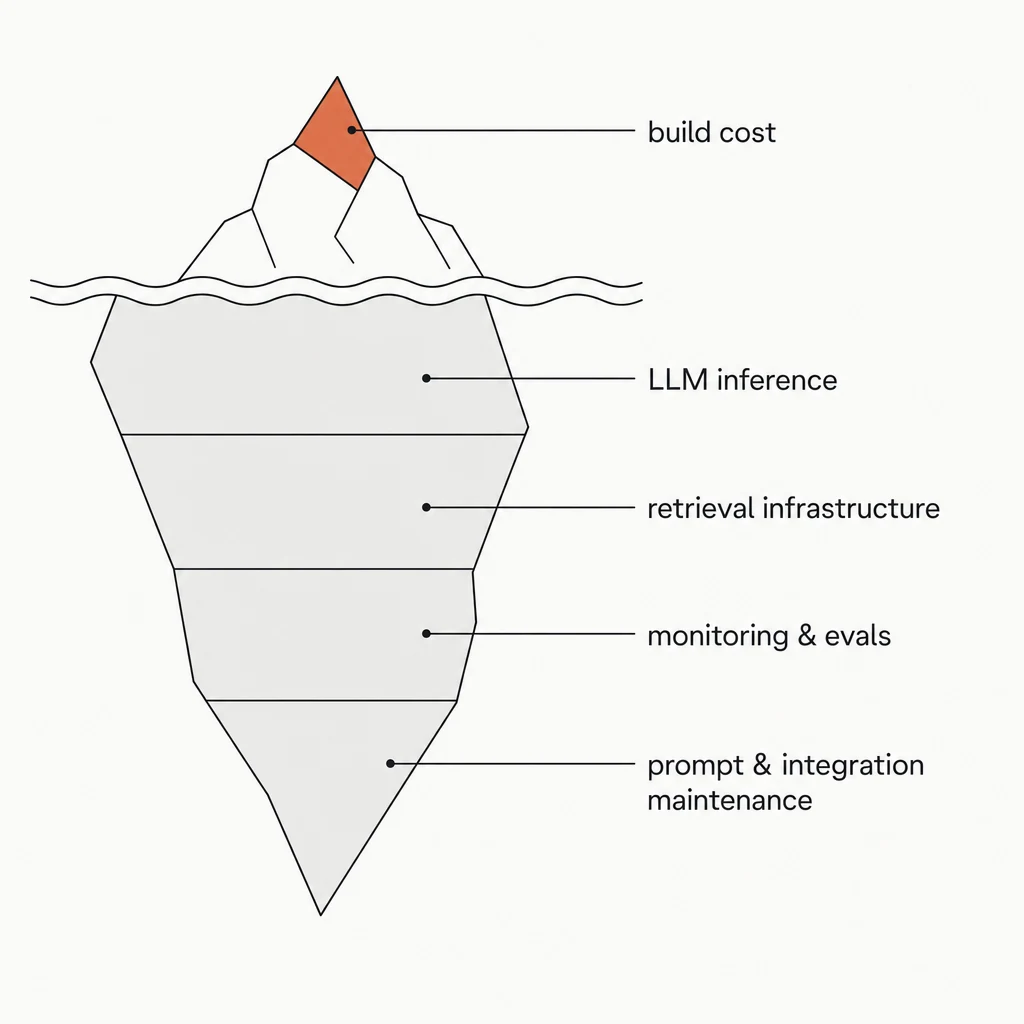
LLM inference (tokens)
The line item everyone models — and still underestimates. Volume times tokens per run times model price; a complex agent burns 5–7× the tokens of a simple one on the same task count. Model choice alone moves this bill several-fold.
Retrieval infrastructure
If the agent answers from your data, a vector store and its hosting come with it — typically hundreds of dollars a month, more at enterprise document volumes. Cheap to run, expensive to forget.
Monitoring & evals upkeep
The eval suite that gated the launch keeps running after it: accuracy tracking, drift alerts, cost-per-run dashboards. Skipping it doesn't remove the cost — it converts it into incidents your customers find first.
Prompt & integration maintenance
Your policies change, your systems get updated, models get deprecated. Somebody owns keeping the agent true. In our engagements this is what the dedicated team covers; in-house, budget real engineering hours for it.
Worked examples from the calculator's own formulas.
Support agent
Multi-step workflow · 2 integrations (helpdesk + CRM) · 20,000 conversations/mo · economy model
The classic first agent: resolves tier-1 tickets, escalates with context.
Back-office document agent
Multi-system autonomy · 4 integrations · 5,000 runs/mo · frontier model
Heavy runs, few of them: invoices, claims, compliance checks. Frontier accuracy pays for itself here.
Self-hosted enterprise agent
Multi-step workflow · 3 integrations · 100,000 runs/mo · models on your infrastructure
At this volume self-hosting beats per-token pricing — and the data never leaves your perimeter.
All three use the exact formulas behind the widget above — set the same sliders and you'll get the same numbers. That's the point: an AI agent budget you can recompute yourself beats one you have to trust.
The crossover: when owning beats renting.
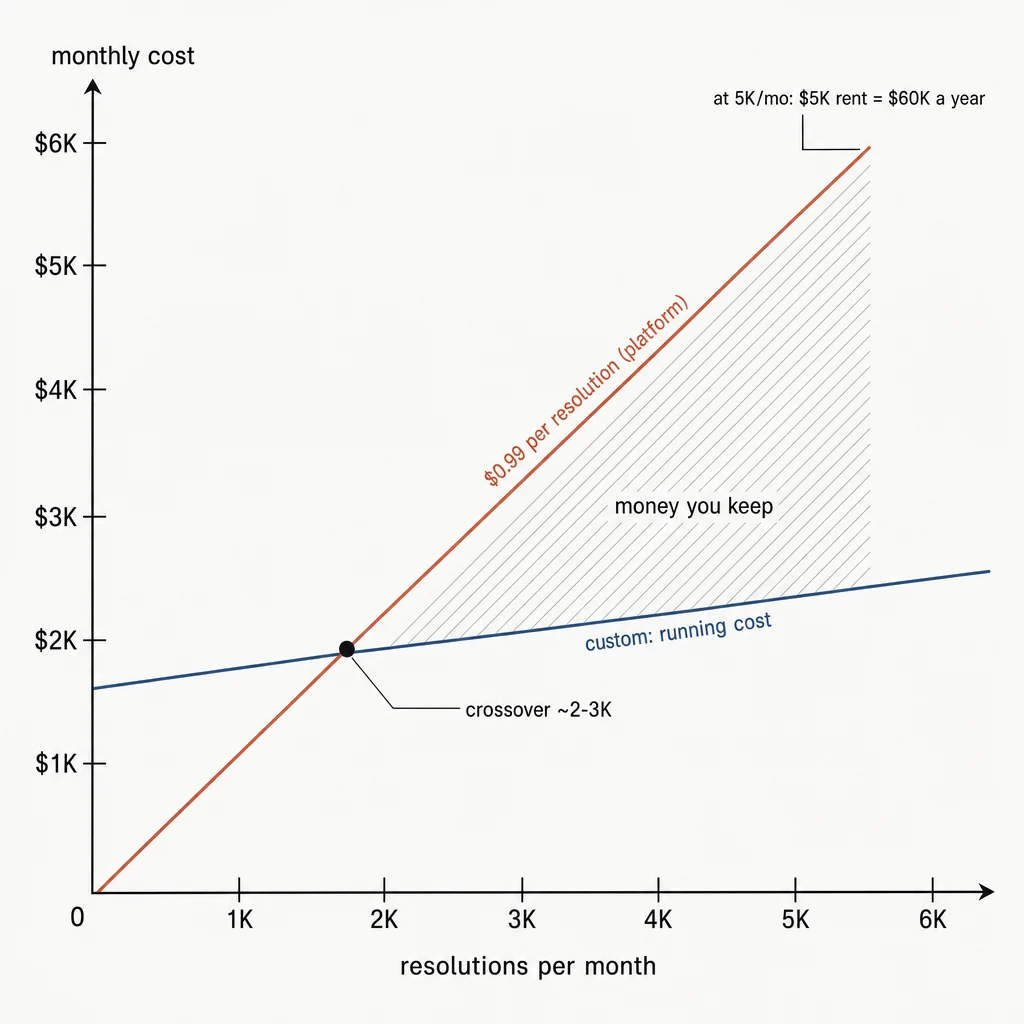
Per-resolution pricing looks harmless at the start: a dollar per closed ticket sounds like nothing. Multiply it out. At 5,000 resolutions a month, a $0.99-per-outcome agent bills about $5K — every month, forever, growing with your success. Twelve months in, you've paid roughly $60K in rent for a system you don't own, can't extend past its platform, and can't take with you.
The same year of budget buys a custom build ($30–50K, yours from day one) plus months of running costs at near-raw inference prices. Below roughly 2–3K resolutions a month the platform genuinely wins — take it, and we'll tell you exactly that. Above it, every month you wait moves money from your side of the table to theirs. That's not a sales pitch; it's multiplication.
Agents against human hours, honestly.
The comparison buyers actually run in their heads isn't agent vs platform — it's agent vs hire. A mid-level operations hire costs $50–80 per hour once benefits and management are counted; the worked examples above land between cents and a few dollars per completed run. But the honest version cuts both ways: an agent only wins on work that's repetitive, well-bounded, and high-volume. A mismanaged agent — no evals, no cost budgets, unbounded retries — can burn more than the human it replaced. That's why every number on this page assumes the unglamorous engineering that keeps agents cheap: evals, monitoring, and spending limits designed in from day one, not bolted on after the first scary invoice.
The questions behind the question.
How much do AI agents cost to run each month?
The cost of an AI agent each month is volume times work per run. A support agent handling 20,000 conversations a month on an economy-tier model costs hundreds of dollars in inference; the same volume on a frontier model with complex multi-step runs can reach thousands. That's why the calculator above asks about volume and complexity — AI agent cost per month is arithmetic, not mystery. Monitoring and evals infrastructure add a baseline on top.
What drives AI agent development cost up or down?
Three things, in order: how many systems the agent must act on (each integration is real engineering), whether everything must run on your infrastructure (self-hosting adds deployment and ops work), and how much can go wrong when the agent acts (guardrails and evals scale with blast radius). Conversation-only agents sit at the bottom of the range; multi-system autonomous workflows at the top — agentic AI development cost follows the same three drivers.
What's the cost to build an AI agent in-house instead?
The honest math: the cost to build AI agent capability in-house starts with two senior engineers for a quarter — $80–120K in salary before the agent meets production — plus the ongoing ownership. Frameworks like LangGraph make the prototype cheap; evals, guardrails, and integration work are where the budget actually goes. If AI is your forever-core, build in-house; if you need production this quarter, a fixed-price pilot is faster and capped.
How much does agentic AI cost compared to a chatbot?
Yes, and the difference is the action surface. A chatbot that only answers questions is cheaper to build and to run — fewer tokens per interaction, no write-access to your systems, smaller guardrail budget. Agentic AI cost grows with every system the agent can touch, because each one needs integration, permissions, and testing. If you only need answers, start with a chatbot — the cost of agentic AI is a premium you pay for autonomy you actually use.
What does an AI voice agent cost on top?
Voice adds telephony and real-time speech to the same agent core: AI voice agent cost includes per-minute telephony and speech models plus the engineering for sub-second turn-taking. Platform AI voice agent pricing is per-minute; custom flips it to fixed build plus near-raw inference. Build cost sits in the upper pilot range; running cost adds roughly the speech stack on top of the numbers above. Our voice stack handles thousands of calls a day in production, so these estimates come from live systems.
Is an AI agent cheaper than hiring for the same work?
For repetitive, high-volume, well-bounded work — usually yes, by an order of magnitude per task: cents to low dollars per run against $50–80 per human hour. For judgment-heavy, low-volume, or constantly changing work the human wins, and pretending otherwise is how AI projects end up in postmortems. The expensive failure mode isn't the agent's bill — it's automating the wrong workflow. That's what the scoping call is for.
How does AI agent pricing work on platforms vs custom?
Platforms charge per seat, per minute, or per conversation — AI agents price out cheaply at low volume and painfully at high volume, because the margin scales with your usage. Custom flips the curve: fixed build cost, then near-raw inference prices. Agentic AI pricing follows the same curve, whatever the label: platform AI agents pricing scales with your success, pricing for AI agents you own doesn't. The crossover typically arrives when usage-based fees pass the low thousands per month. Below it, take a platform; above it, owning the stack wins — and if you're still weighing how much does an AI agent cost at your volume, that's exactly what a scoping call settles.